
Do I Need a SWPPP? California Construction General Permit Requirements
Quick answer: In California, you need a SWPPP if your construction project disturbs one acre or more of soil — or less than one acre but is part of a larger common plan of development or sale. Coverage is required under the statewide Construction General Permit (Order 2022-0057-DWQ, effective September 1, 2023). Even some sub-acre projects need one if a city, county, or an existing TMDL requires it. When in doubt, a Qualified SWPPP Developer (QSD) can confirm in a quick review.
Below is a simple way to figure out whether your project is covered — and exactly what to do if it is.
Not sure where you stand? Zila is California’s most trusted name in preparing SWPPPs.
We’ll confirm your requirements for free.
The 1-acre rule (start here)
The primary trigger is total disturbed area, not building size. “Disturbed” means any soil-disturbing activity: clearing, grading, grubbing, excavation, stockpiling, or trenching.
- 1 acre (43,560 sq ft) or more disturbed → you need permit coverage and a SWPPP.
- Under 1 acre, standing alone → usually no state permit, but check local rules (see below).
- Under 1 acre, but part of a larger common plan → you need coverage. A half-acre lot inside a 20-acre subdivision is covered because the whole plan exceeds an acre.
That “common plan of development or sale” clause catches a lot of contractors off guard. If your parcel is one phase of a bigger master-planned project, the acre threshold is measured against the entire development, not just your slice.
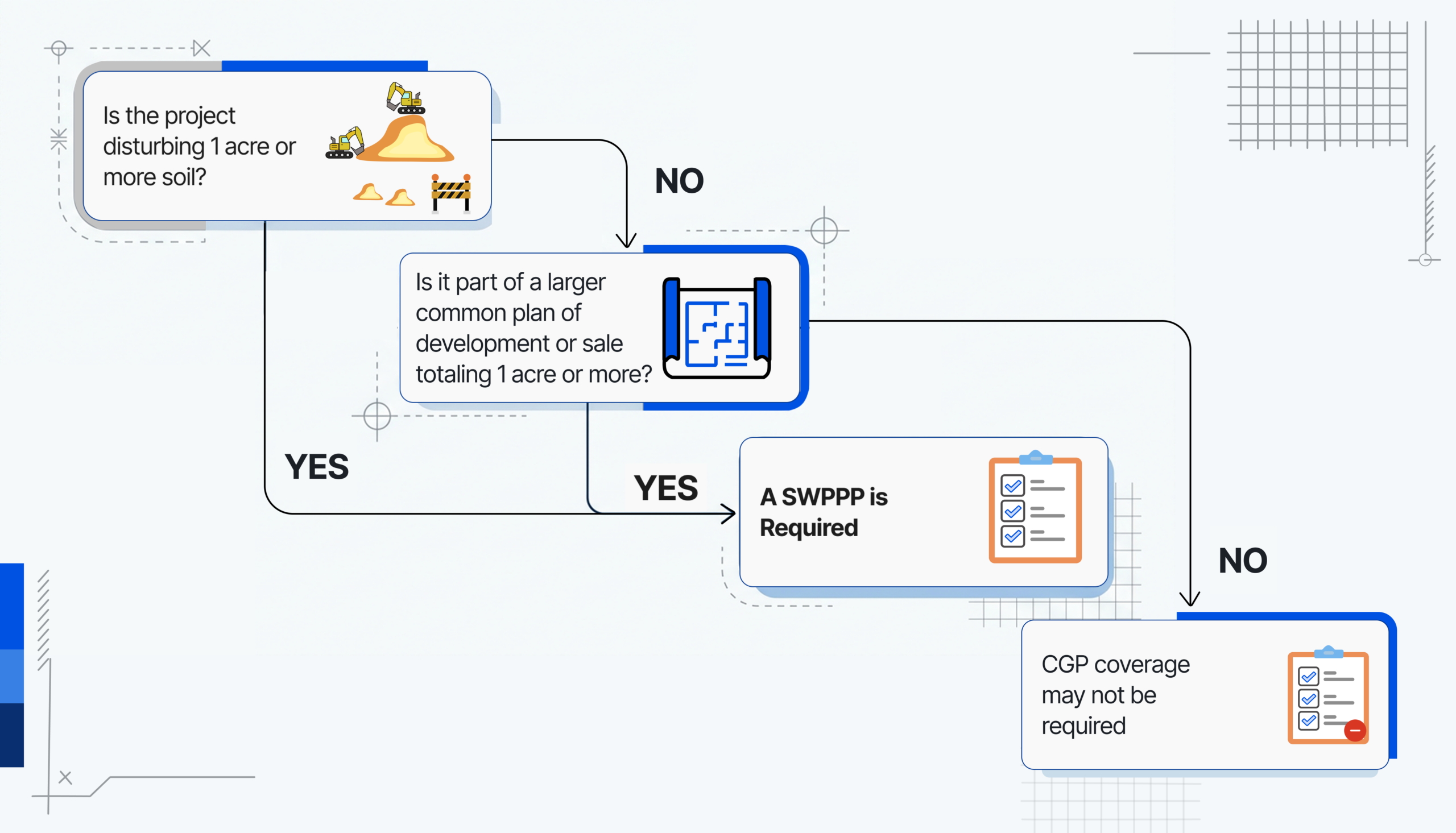
A quick decision checklist
Ask these in order:
- Will the project disturb 1+ acre of soil in total? → If yes, you need a SWPPP.
- Is it under an acre but part of a larger common plan of development or sale? → If yes, you need a SWPPP.
- Does your city or county require erosion/sediment control or a local WPCP for smaller sites? → Many California municipalities do; if yes, you need a plan (sometimes a WPCP rather than a full SWPPP).
- Is the receiving water covered by a sediment-related TMDL, or is the site otherwise flagged? → Additional requirements may apply.
If you answered “yes” to any of the above, the next section is for you.
What “coverage” actually involves
Getting a SWPPP isn’t a single form — it’s enrollment in the Construction General Permit. Here’s the sequence:
- Risk-level determination. Your QSD calculates the project’s Risk Level (1, 2, or 3) from its sediment risk and the sensitivity of the receiving water. Higher risk levels carry more monitoring, sampling, and rain-event obligations.
- SWPPP preparation. A QSD writes the site-specific plan — site map, BMPs, inspection procedures, and (for higher risk levels) a Rain Event Action Plan.
- SMARTS filing. The project owner (the “Legally Responsible Person”) files a Notice of Intent (NOI) and uploads Permit Registration Documents through the state’s SMARTS system.
- WDID number issued. Once accepted, the site receives a WDID number proving coverage — many cities require this before releasing a grading permit.
- On-site implementation & inspections. A QSP installs/maintains BMPs and performs the required inspections and sampling throughout construction.
- Notice of Termination (NOT). When the site is finalized and stabilized, the owner files a NOT to end coverage and stop annual fees.
What changed under the 2022 permit (and why it matters)
California replaced the old 2009-0009-DWQ permit with Order 2022-0057-DWQ, effective September 1, 2023. Many contractors — and a lot of older online guides — still reference the outdated 2009 order. Key updates in the current permit include stronger requirements around passive treatment technologies, updated TMDL implementation provisions for impaired waters, and revised Permit Registration Document (PRD) requirements. If your compliance paperwork or your consultant still cites the 2009 order, that’s a red flag worth checking.
Linear projects, utilities, and demolition
The permit also covers Linear Underground/Overhead Projects (LUPs) — think pipelines, utility trenching, and cable runs — which have their own SWPPP considerations. Demolition, if it disturbs soil at or above the threshold, can trigger coverage too. These edge cases are exactly where a quick QSD review saves you from a compliance surprise mid-project.
When it’s unclear, ask the experts.
Zila is California’s most trusted name in preparing SWPPPs, and we offer customized pricing plus price matching.
Not sure? Get a 5-minute answer
The fastest way to know for certain is to have a Qualified SWPPP Developer look at your site size, location, and receiving waters. Zila is California’s most trusted name in preparing SWPPPs — our QSDs will confirm whether you need coverage, determine your Risk Level, prepare and file everything through SMARTS, and provide QSP inspections once you break ground, all with customized pricing and price matching. We work with contractors, developers, and agencies across California, including Los Angeles, Anaheim, Santa Ana, Moreno Valley, and Victorville.
Related reading: What Is a SWPPP? and How Much Does a SWPPP Cost in California?
Frequently Asked Questions
- Do I need a SWPPP for less than one acre?
Usually not for a stand-alone sub-acre site, but you do if it’s part of a larger common plan of development or sale, or if your city, county, or a local TMDL requires erosion and sediment controls.
- What is the disturbed-acreage threshold for a SWPPP in California?
One acre (43,560 square feet) of total soil disturbance triggers coverage under the Construction General Permit — measured across the entire common plan of development, not just a single lot.
- What permit governs SWPPPs in California right now?
The current statewide permit is Order 2022-0057-DWQ, effective September 1, 2023, which replaced the older 2009-0009-DWQ order.
- What is a WDID number?
A WDID (Waste Discharge Identification) number is issued through SMARTS once your Notice of Intent is accepted. It proves permit coverage and is often required before a city will issue your grading permit.
- Who determines my project’s Risk Level?
A Qualified SWPPP Developer (QSD) calculates your Risk Level (1, 2, or 3) based on the site’s sediment risk and the sensitivity of the receiving water.
Table of Contents
Get a Free Quote
Tell us what you need and we’ll respond with pricing details.
No obligation. Response within 24 hours.



Latest Insights
-
EPA SWPPP: The Federal Construction General Permit Explained
Quick answer: An EPA SWPPP is a Stormwater Pollution Prevention Plan required under the federal Construction General Permit (CGP) — the National Pollutant Discharge Elimination System (NPDES) permit the U.S. EPA issues for construction that disturbs one acre or more of land (or less, if part of a larger common plan of development). A SWPPP is a nationwide Clean Water…
-
Does a SWPPP Save Money? How the Right Plan Cuts Costs
Quick answer: Yes — a well-designed SWPPP saves money in three ways: it right-sizes your BMPs so you don’t over-build controls you don’t need or under-build ones that fail; it prevents costly incidents — a sediment discharge or failed control can trigger emergency cleanup, replacement BMPs, and stricter regulator-imposed requirements; and it avoids fines and stop-work orders that can cost tens of…
-
SWPPP Violations & Fines in California: What Non-Compliance Really Costs
Quick answer: In California, a SWPPP violation happens when a construction site fails to have, follow, or properly document its Stormwater Pollution Prevention Plan. Consequences range from a written Notice of Violation to a full stop-work order — and financial penalties that can reach tens of thousands of dollars per day, per violation under the federal Clean Water Act and…